
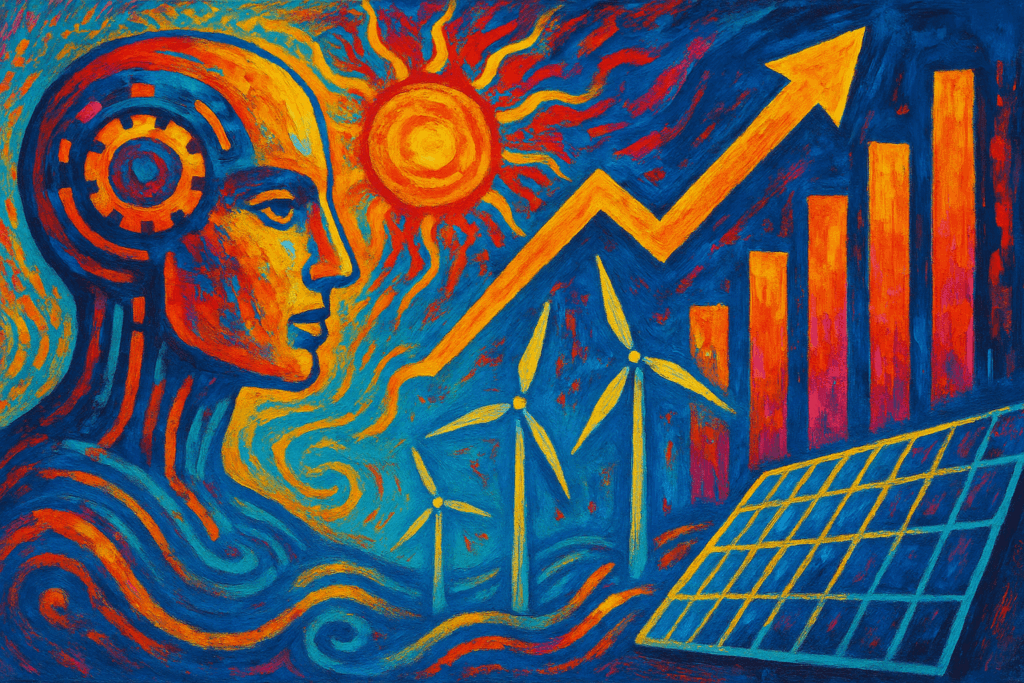
AI’s Impact on Energy Markets
Artificial intelligence and machine learning are reshaping how market participants predict load, variable renewable output, and price moves. Faster models and richer data let traders and operators move from rule-based decisions to probabilistic strategies that reflect real market uncertainty.
Precision Forecasting for Dynamic Grids
AI improves demand and supply forecasts by fusing high-frequency telemetry, weather forecasts, satellite imagery, and market signals into models that learn nonlinear patterns. Techniques such as ensemble models, recurrent neural networks, and gradient-boosted trees produce shorter error bars for short-term load and wind or solar output. Probabilistic forecasts give operators the likelihood of ramps and extremes, which supports reserve procurement, dispatch decisions, and reduced imbalance costs.
AI-Driven Trading Advantages
Traders use AI to convert forecasts into tradable signals. Machine learning identifies intraday arbitrage, optimizes bids in day-ahead and intraday auctions, and adapts to regime changes in volatility. Reinforcement learning and portfolio optimization frameworks permit automated strategies that balance expected return against downside risk. AI also improves risk modeling through scenario generation and conditional value-at-risk estimates, helping desks size positions and hedge more efficiently.
The Future of Smart Energy Trading
Near-term advances will come from better data integration, explainable models, and distributed learning that preserves data privacy across utilities and aggregators. As distributed energy resources and storage scale, AI will coordinate fleets for market participation and grid services. Regulatory focus on model transparency and robust backtesting will shape deployment, but practical gains are already measurable: fewer forecast-driven penalties, tighter bid spreads, and faster arbitrage capture. For market participants, the immediate win is clearer decisions grounded in probabilistic intelligence rather than fixed forecasts.
Practical next steps: deploy probabilistic forecasts in trading systems, incorporate ML-based risk metrics into position limits, and pilot small-scale reinforcement learning strategies with strict safeguards and out-of-sample validation.