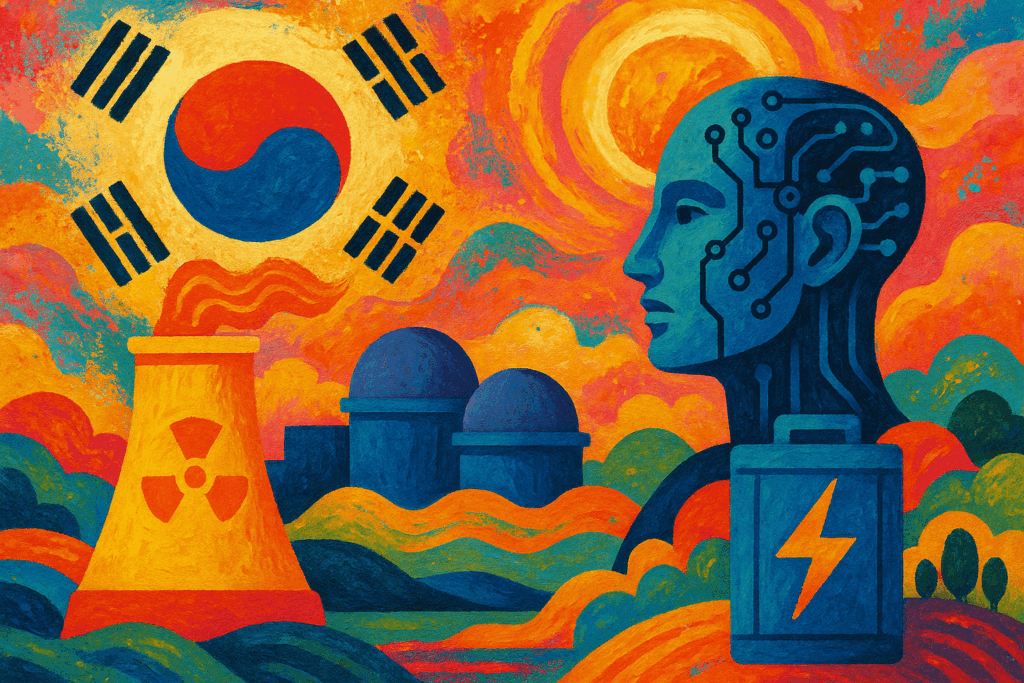
South Korea is shifting its energy policy to meet rapidly rising electricity demand from artificial intelligence workloads. The government’s 11th Basic Power Supply Plan accelerates nuclear build-out while coordinating renewables and large-scale storage to stabilize an isolated grid facing growing, continuous loads from data centers and AI facilities.
AI’s Imperative: Driving Nuclear Revival
The spike in AI compute creates predictable but heavy baseload and peak demands that intermittent resources struggle to meet. Climate, Energy and Environment Minister Kim Sung-hwan and President Lee Jae Myung have framed nuclear as a dispatchable backbone for national energy security. Public opinion has shifted toward expanding nuclear capacity after debates in previous administrations. South Korea’s islanded grid topology raises the value of stable, controllable generation when large AI clusters come online.
Reactor Plans and SMR Integration
The 11th Basic Power Supply Plan specifies two new large reactors totaling about 2.8 GW targeted for operation around 2037 to 2038, plus a 0.7 GW small modular reactor by 2035. Site selection has been expedited to meet those timelines. The SMR is intended to offer flexible, localized generation that can support regional AI centers and provide fast-ramping complement to larger plants.
Integrating Renewables and Energy Storage
Policy pairs nuclear expansion with aggressive deployment of energy storage systems and pumped-storage hydropower to manage renewable intermittency. Utility-scale ESS, frequency regulation capacity, and multi-hour pumped-storage reservoirs are planned to absorb variable wind and solar output and to provide reserve for AI-driven load swings. Storage is positioned as the operational buffer that lets renewables scale without compromising reliability.
Future Energy Mix and Global Implications
South Korea aims to phase down coal while relying on nuclear plus renewables and storage for a low-carbon stable grid. For technology investors and energy planners, Korea’s model highlights how policy can align long-lead nuclear projects with faster-deploying storage to meet AI-era demand. Other countries with concentrated AI infrastructure and constrained grids will watch Korea’s timelines and procurement strategies as a working example for combining large reactors, SMRs, and storage into a resilient energy architecture.