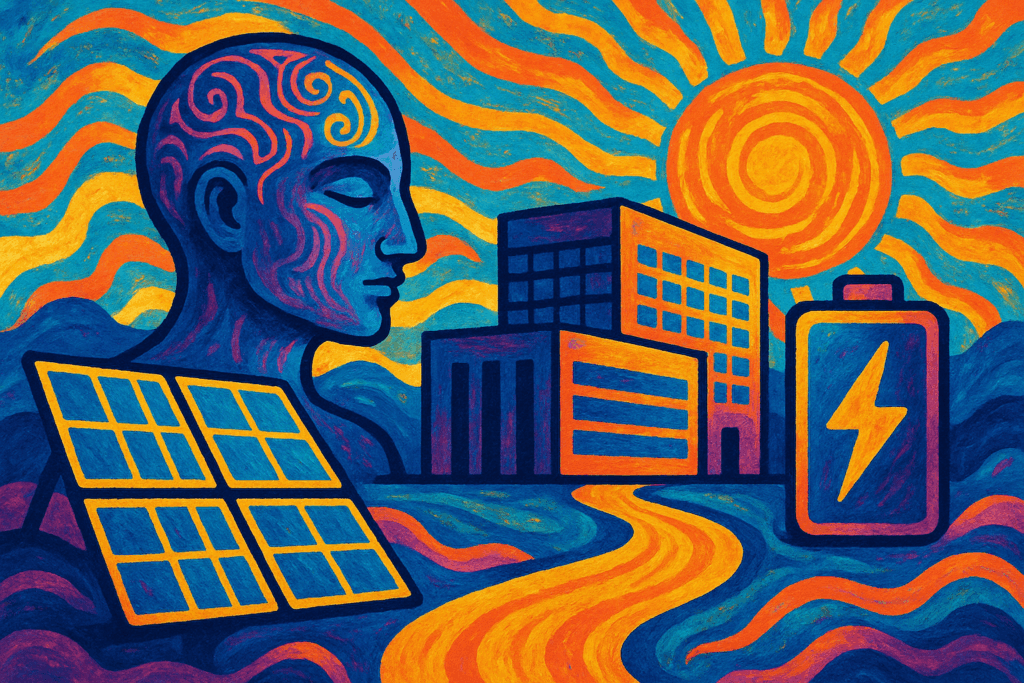
The rapid rise of large AI models makes power design for AI data centers fundamentally different from that of conventional facilities. Solar-plus-storage is appealing, but integrating renewables for AI workloads requires tailored engineering, active grid coordination, and policy updates. Industry voices such as Hitachi Energy stress that a plug-and-play approach will not meet AI demand patterns or grid reliability requirements.
The unique energy demands of AI workloads
AI training and inference, driven by dense GPU clusters and parallel computing, create sustained high loads and frequent sharp demand spikes. Unlike typical data center IT loads that vary slowly, AI bursts can raise power draw by tens of percent within seconds and persist for hours. Those rapid transitions stress power systems, create power quality challenges, and raise the risk of local congestion and frequency deviation on weak grids.
Tailored storage and active grid integration
Energy storage becomes more than capacity. Battery energy storage systems provide bulk energy to shift solar output and carry sustained loads. Supercapacitors and hybrid power electronics handle very fast, repeated transients and protect power quality. The optimal mix depends on measured load profiles, duty cycles, and site constraints.
Active grids coordinate generation, storage, and demand in real time rather than operating passively. With telemetry and automated controls, an active grid can schedule AI training windows, dispatch storage for bursts, and participate in wholesale markets. Compliance with grid codes is essential. Data centers can act as responsive resources through demand response, flexible scheduling of training jobs, and participating in frequency response services, helping them behave as reliable grid participants.
Economics and collaborative paths forward
Solar and wind have low levelized costs, but integration expenses, market rules, interconnection upgrades, and operational constraints shape total project economics. Early collaboration among utilities, developers, hyperscalers, and regulators is required to coordinate site design, interconnection planning, and grid code updates. Joint planning lowers risk, reduces costly retrofits, and helps secure financing.
AI-ready solar-plus-storage is feasible but not simple. It calls for precise storage sizing, hybrid technologies, active grid functions, and policy frameworks that reward predictable, grid-friendly behavior from data centers.