Nvidia & Dassault Systèmes Unite for AI-Powered Industrial Innovation
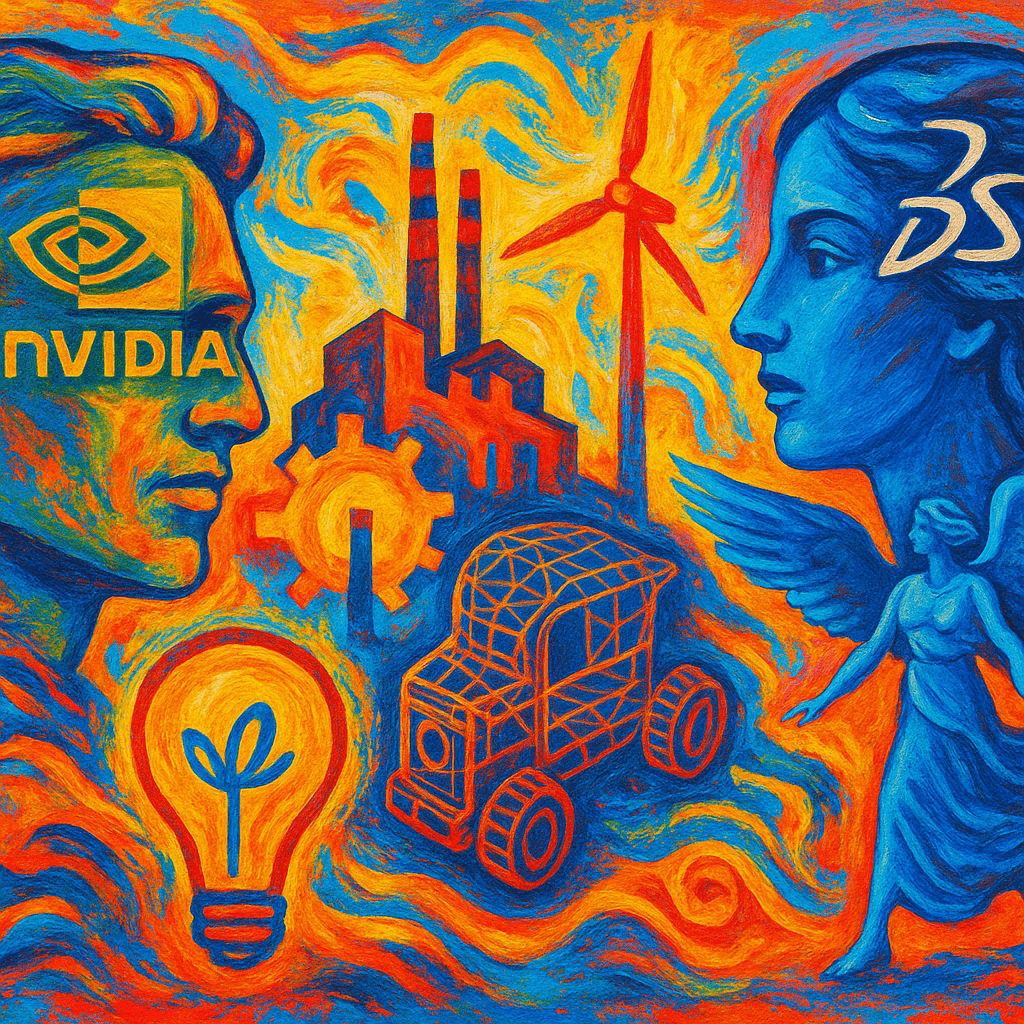
Nvidia and Dassault Systèmes announced a strategic partnership to combine Nvidia’s accelerated computing and AI stack with Dassault’s 3DExperience platform, including OUTSCALE cloud services. The aim is to create comprehensive virtual twins and industry world models that speed engineering cycles, reduce testing overhead, and open pathways to lower energy consumption across manufacturing, utilities, and data centers.
A Foundational Shift for Industrial AI
The collaboration intends to merge Nvidia Omniverse’s real-time simulation and Rubin platform capabilities with Dassault’s model-based systems engineering. Dassault’s OUTSCALE will leverage Nvidia AI for scalable cloud services, while Nvidia will incorporate Dassault’s system modeling into its Omniverse DSX Blueprint and AI factory workflows. These integrations create synchronized digital replicas where behavior follows physical laws, allowing validations at scale before physical rollout.
Jensen Huang said, “Combining our computing and simulation tools with Dassault’s system models will let industries test real-world scenarios faster and with less waste.” Pascal Daloz added, “Customers can model, validate, and operate complex systems virtually, reducing risk and shortening time to value.” These comments underline a shared focus on reliability, traceability, and industrial-grade AI governance.
Physical AI: Transforming Industries and Energy Use
Physical AI refers to AI systems grounded in physics, chemistry, and material models so predictions respect real-world constraints. Applied to materials science, plant operations, and product design, this approach reduces prototype cycles and material waste while improving operational efficiency. For energy systems it matters in multiple ways: virtual twins enable thermal and power flow optimization in data centers, predictive maintenance that lowers downtime and energy loss, and co-simulation of renewables and storage to improve grid flexibility.
By pairing generative AI for design with trustworthy, model-based verification, the partnership supports a generative economy that scales sustainable practices. Engineers can iterate on low-carbon designs faster, manufacturers can cut energy use through optimized process control, and investors can evaluate lifecycle emissions with higher confidence. For energy professionals, this is a practical route to measurably reduce consumption and speed deployment of green technologies.
The Nvidia and Dassault tie-up signals an industrial pivot where AI infrastructure and virtual twins do more than accelerate product development. They offer a toolkit to shrink energy footprints, lower resource intensity, and build resilient industrial systems for the decade ahead.