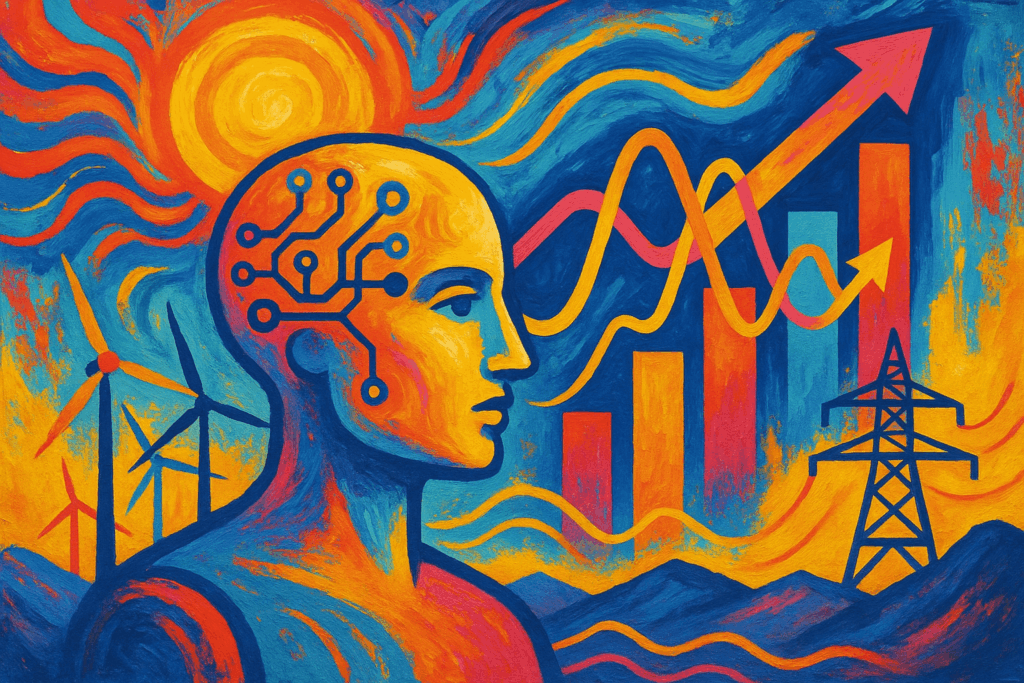
Data: The Energy Market’s New Currency
Data now underpins decisions that once relied on fuel, infrastructure and regulation. Meter reads, sensor telemetry, weather feeds and market ticks form the raw material for trading strategies, risk models and operational planning. For traders and asset owners, high-frequency, clean data converts uncertainty into tradable signals and new revenue streams.
AI’s Precision in Forecasting and Grid Stability
Machine learning models and time-series forecasting fuse weather, historical load, asset health and market prices to predict demand and generation with far greater resolution. Smart meters and distributed sensors enable short-term demand response and longer-term capacity planning. Algorithms that optimize variable renewables reduce imbalance costs and lower reserve needs; experiments by teams like DeepMind have shown how data-driven control can cut margin losses and smooth operations.
Unlocking New Energy Trading Opportunities
AI turns forecasts into market action. Dynamic pricing engines and automated bidding tools use predicted supply and demand to set optimal offers across intraday and balancing markets. Prosumers and peer-to-peer platforms use tokenization and smart contracts to trade locally, while portfolio managers use ensemble models to arbitrate between markets and storage assets. The result is tighter spreads, faster discovery of value and fresh investment avenues in flexibility and virtual power plants.
The Dawn of Cognitive Energy Systems
Cognitive systems learn from performance and self-optimize across time. That means self-stabilizing loads, autonomous microgrids that reconfigure for resilience and systems that prioritize equity of access during scarcity. As intelligence migrates to the edge, orchestration shifts from central dispatch to coordinated autonomy, expanding opportunities for innovators and smaller market participants.
Conclusion: A Data-Driven Energy Revolution
AI and data are remaking how energy is produced, priced and traded. For market participants the immediate mandate is to capture quality data, adopt predictive models and redesign trading operations to monetize flexibility. Privacy, data governance and geopolitical risks will shape who benefits, but the commercial pathway is clear: smarter forecasts lead to sharper trading advantage.