Infosys & ExxonMobil Tackle AI’s Energy Challenge
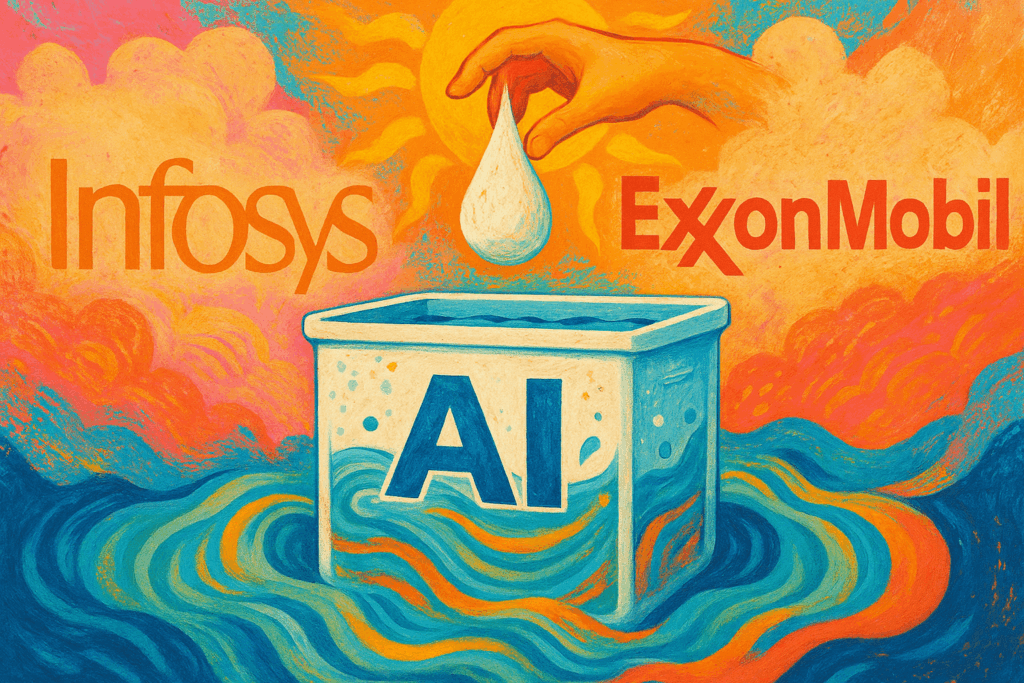
Infosys and ExxonMobil have formed a strategic collaboration to develop and deploy liquid immersion cooling solutions for AI and high performance computing data centers. As generative AI workloads grow, compute density and power draw are rising faster than traditional air cooling can handle. The partnership brings together ExxonMobil’s fluid chemistry and thermal management knowledge with Infosys’s AI optimization and cloud deployment platforms to reduce energy use and carbon intensity for large-scale AI infrastructure.
Immersion Cooling: A Greener Solution
Liquid immersion cooling submerges servers in a nonconductive dielectric liquid that transfers heat away from components more efficiently than air. ExxonMobil supplies advanced dielectric fluids designed for thermal stability, low viscosity, and electronics compatibility so racks can run hotter and denser without risking hardware. Compared with conventional air-cooled systems, immersion reduces the need for power-hungry chillers, lowers fan and HVAC loads, and can cut water use tied to cooling.
Infosys contributes two operational layers. Topaz, its generative AI optimization suite, analyses workload patterns and schedules processing to minimize thermal peaks and shift tasks to periods or locations with cleaner power. Cobalt, Infosys’s cloud and managed services offering, integrates immersion hardware into scalable deployment models, handling orchestration, monitoring, and hybrid cloud connectivity so operators can roll out immersion across facilities with repeatable controls.
Driving Sustainable AI Infrastructure
Combined, ExxonMobil’s dielectric liquid and Infosys’s Topaz and Cobalt create a system-level approach: chemical innovation for heat removal, AI for workload-level efficiency, and cloud tooling for repeatable deployment. For data center operators and sustainability teams this translates into lower operational energy, reduced cooling overhead, and a pathway to shrink carbon footprints as AI capacity expands.
The partnership signals an emerging model where energy-sector engineering teams and digital infrastructure providers collaborate directly. That cross-industry approach will matter as enterprises and cloud providers balance performance demands of AI with tighter sustainability targets.
For decision makers: evaluate immersion pilots with workload-aware orchestration and vendor plans for lifecycle fluid handling and hardware warranties.